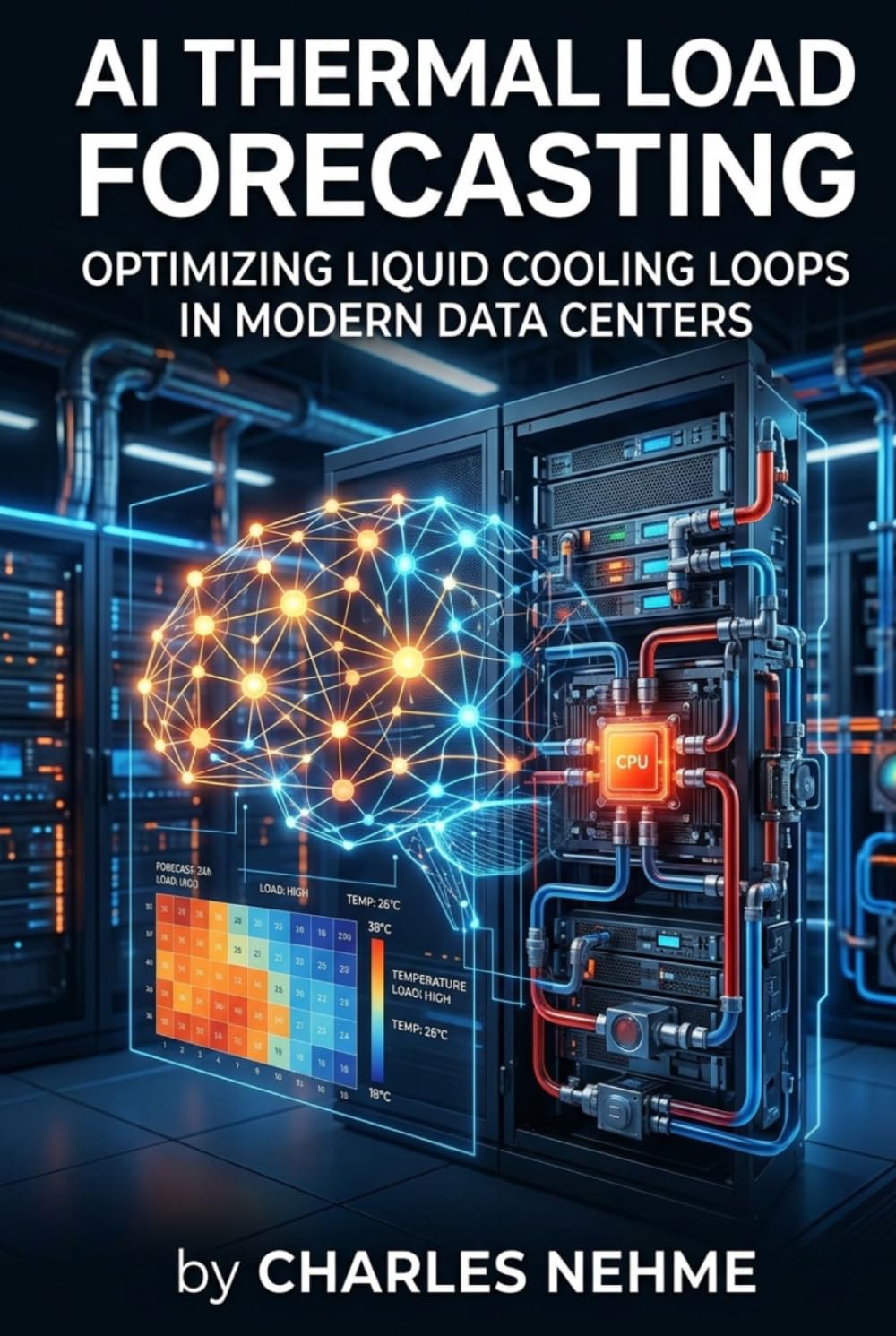
ler totalmente AI Thermal Load Forecasting: Optimizing Liquid Cooling Loops in Modern Data Centers
por Charles Nehme
Leia uma amostra
AI Thermal Load Forecasting: Optimizing Liquid Cooling Loops in Modern Data Centers
The rapid expansion of artificial intelligence, high-performance computing, and accelerated computing is fundamentally changing the thermal characteristics of modern data centers. Traditional cooling strategies, designed around relatively predictable server workloads and moderate rack densities, are increasingly being challenged by GPU clusters and other high-density computing platforms. Modern AI servers can transition rapidly between relatively low and extremely high computational loads. These changes can produce significant variations in heat generation over very short periods. A cooling system that reacts only after temperatures begin to rise may therefore be operating behind the actual thermal event. This book examines a different approach: predictive thermal management. Instead of waiting for rack temperatures to indicate that additional cooling is required, an intelligent cooling system can use real-time information about processor power, server utilization, workload behavior, coolant temperatures, flow conditions, and historical operating patterns to anticipate future thermal demand. The objective is not simply to make cooling systems more sophisticated. It is to make them more responsive, more energy efficient, and more thermally stable. At the center of this approach is the integration of artificial intelligence with liquid-cooling infrastructure. Predictive models can estimate upcoming thermal loads and provide advance information to the cooling-control system. Variable-speed pumps can then adjust coolant circulation before high-density racks reach critical operating conditions. This creates an important transition from reactive cooling to predictive cooling. Liquid cooling is particularly well suited to this strategy because coolant flow can be actively controlled and directed toward the areas experiencing the greatest thermal demand. Direct-to-chip cooling, cold plates, coolant distribution units, manifolds, valves, pumps, and heat exchangers can become part of an integrated thermal-control system. However, artificial intelligence should not replace fundamental engineering safeguards. A neural network can make predictions, but it should not be trusted as the sole protection against excessive temperature, insufficient flow, equipment failure, or other hazardous conditions. The most practical architecture combines AI-based prediction with conventional control logic, hard operating limits, alarms, redundancy, and emergency protection. This book therefore approaches AI thermal forecasting from an engineering implementation perspective.
Procurando AI Thermal Load Forecasting: Optimizing Liquid Cooling Loops in Modern Data Centers? Aqui você encontra tudo sobre este livro de Charles Nehme em 1 de setembro de 2026. Nesta página estão a descrição da obra, os detalhes da edição (178 páginas) e os formatos disponíveis para baixar: pdf, epub, txt, djvu. Se você gosta de Livros Internacionais, Engenharia e Transporte, Engenharia, Civil, Construção, Aquecimento, Ventilação e Ar Condicionado, explore também outros títulos da mesma categoria no Encontrando os melhores livros. Veja ainda as outras obras de Charles Nehme em nosso catálogo.











Autores populares
Icon Group International (283) Publishing lmgdaw (250) Nikolay Krechet (145) Kennie B Journals (120) Charles Nehme (117) Riddler Books (105) webmarbook design (104) Mint and Cherry Notebooks (82) Jillo Trukudo (80) Ondrej Sarek (76) Iwona Makara (74) Just Visualize It (72) Moonpeak Library (69) Quick Witted Coconut (69) Mary Hirose (67) Talor Press (67) Various (67) Marina Buchholz B.Eng (58) Miller Sye (58) NAK Legal Publishing (58)Principais publicadores
Independently published Forgotten Books Routledge Taschen Dover Publications Wiley Oxford University Press CRC Press Kessinger Publishing Princeton University Press Cambridge University Press Springer Bloomsbury Academic O'Reilly Media Hal Leonard Publishing Corporation Tuttle Publishing Rizzoli International Publications Content provided by MemoryLane.com Editorial Tirant lo Blanch Thames & Hudson