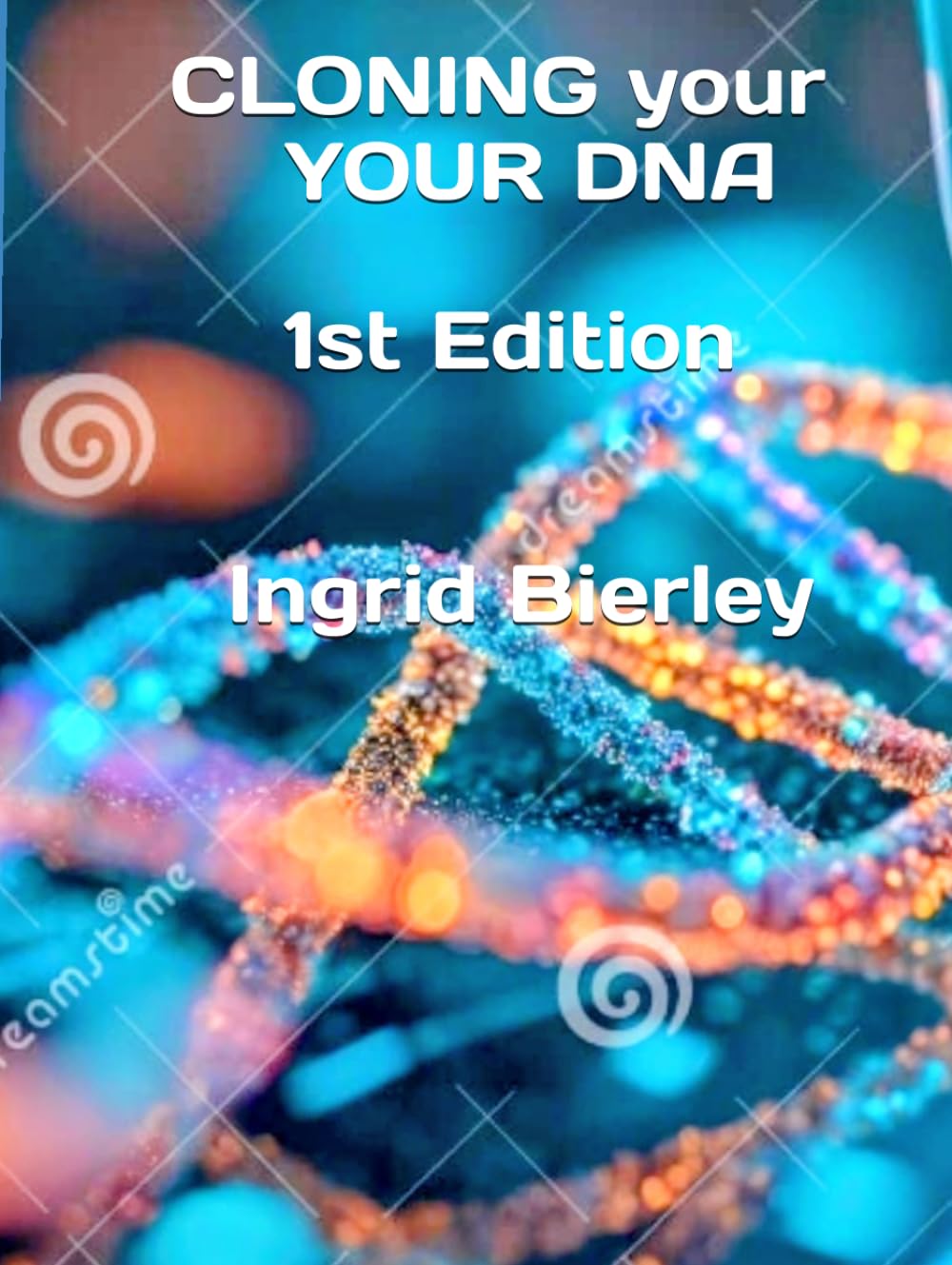
CLONING YOUR DNA: 1ST EDITION
Imagine being able to look at the tiny biological instructions inside your body and understand what makes you uniquely you. Every cell in the human body contains DNA a remarkable molecule that carries the instructions involved in building, maintaining, and operating a living organism. DNA is sometimes described as the body's biological blueprint, but it is much more than a simple blueprint. It is a complex information system that scientists are still learning to understand.
The idea of copying DNA has fascinated scientists, writers, and the public for decades. Today, DNA can be copied and analyzed in laboratories, genes can be studied and modified, and cells can sometimes be reprogrammed into different states. These developments have opened doors to areas of medicine, genetics, biotechnology, agriculture, forensic science, and reproductive research that once seemed impossible.
This book, HOW TO CLONE YOUR DNA, takes the reader on a journey into that fascinating world.
But what does it actually mean to "clone your DNA"?
There is an important distinction between copying DNA and cloning an entire human being. Scientists routinely make copies of specific DNA sequences for research and medical purposes. Creating a genetic copy of an entire organism is a far more complicated process. And creating a genetically identical human being raises enormous scientific, ethical, legal, and social questions.
Understanding that difference is the first step toward understanding cloning.
The Story Begins With DNA
DNA, short for deoxyribonucleic acid, is found in nearly every cell of the human body. It contains genetic information inherited from our biological parents. The familiar double-helix structure of DNA became one of the most recognizable images in modern science after the structure was described in 1953.
Inside DNA are sequences called genes. Genes contribute to characteristics and biological processes by providing instructions for making functional molecules, particularly proteins. However, our lives are not determined by DNA alone. Environment, nutrition, development, experiences, and many other factors interact with our genetic information.
This is one reason cloning is much more complicated than simply making a perfect biological "copy."
From DNA Copying to Cloning
Modern biotechnology provides several different meanings for the word cloning.
Scientists may clone a DNA fragment for laboratory research. They may create genetically identical cells for a particular experiment. Researchers can also study cloning of organisms using techniques such as somatic cell nuclear transfer.
The famous sheep Dolly, born in 1996, became an important milestone in cloning research because she was the first mammal cloned from an adult somatic cell. Dolly demonstrated that genetic material from a mature cell could be used to create an organism under the right experimental conditions.
Her story changed the public conversation about cloning.
It also produced an important question:
If scientists can clone an animal, could they eventually clone a person?
The answer is not as simple as science-fiction stories sometimes suggest.
What This Book Will Explore
In the pages ahead, we will explore the science behind DNA and cloning in language that ordinary readers can understand.
We will begin with the foundations: What is DNA? Where is it found? How is genetic information organized? How do cells copy their DNA? What makes one person genetically different from another?
From there, we will examine the history of cloning research and the major scientific discoveries that brought cloning from an idea into a laboratory reality.
Procurando CLONING YOUR DNA: 1ST EDITION? Aqui você encontra tudo sobre este livro de INGRID BIERLEY em 9 de setembro de 2026. Nesta página estão a descrição da obra, os detalhes da edição (317 páginas) e os formatos disponíveis para baixar: pdf, epub, txt, djvu. Se você gosta de Livros Internacionais, Ciências Tecnológicas, Experiências e Metodologia, Experiências e Projetos, explore também outros títulos da mesma categoria no Encontrando os melhores livros. Veja ainda as outras obras de INGRID BIERLEY em nosso catálogo.








Autores populares
Icon Group International (283) Publishing lmgdaw (250) Nikolay Krechet (145) Kennie B Journals (120) Charles Nehme (106) Riddler Books (105) webmarbook design (103) Mint and Cherry Notebooks (82) Jillo Trukudo (80) Ondrej Sarek (76) Iwona Makara (74) Just Visualize It (71) Moonpeak Library (69) Quick Witted Coconut (69) Mary Hirose (67) Talor Press (67) Various (67) Marina Buchholz B.Eng (58) Miller Sye (58) NAK Legal Publishing (58)Principais publicadores
Independently published Forgotten Books Routledge Taschen Dover Publications Wiley Oxford University Press CRC Press Kessinger Publishing Princeton University Press Cambridge University Press Springer Bloomsbury Academic O'Reilly Media Hal Leonard Publishing Corporation Tuttle Publishing Rizzoli International Publications Content provided by MemoryLane.com Editorial Tirant lo Blanch Thames & Hudson